Tag Archive for: NM PFAS

New Mexico PFAS in Products Rule Appealed

A legal challenge has been filed in state court against New Mexico’s PFAS in products rule, which was finalized last month.

As noted in a recent Chemical Watch article, concerns center on product labeling issues that emerged during the rulemaking process.  The final rule’s labeling requirements apply to all products containing intentionally added PFAS manufactured on or after January 1, 2027, with narrow exceptions.

More details will become available after the appellant files a docketing statement, due within 30 days of the suit’s filing on May 22, 2026.  The notice of appeal can be found here.

For more on the rulemaking, view our New Mexico PFAS archive.

New Mexico Adopts Nation’s Most Far-Reaching PFAS Labeling Rules

Update (April 23, 2026)

The final rule, as submitted to New Mexico State Records Center and Archives, is available here.  The final order and statement of reasons, dated April 17, can be found here.  The rule is slated for publication in the May 5, 2026, volume of the New Mexico Register.

* * *

New Mexico has approved “universal” PFAS labeling requirements beginning in 2027, according to the New Mexico Environment Department (NMED).

The Environmental Improvement Board approved the requirements on March 23, 2026.  Although the final rule is not yet available, the final proposed rule requires the term “PFAS” inside an Erlenmeyer flask on all products containing intentionally added PFAS manufactured on or after January 1, 2027.  “PFAS” is broadly defined by statute to include all substances with at least one fully fluorinated carbon atom.

Only used products, pesticides, veterinary products, and medical devices and drugs are exempt from the labeling requirements.  Although the controlling statute includes additional exemptions from PFAS prohibitions and reporting requirements, the final proposed rule does not extend them to labeling.  Manufacturers may, however, request a labeling waiver if the product falls within one of the statutory exemptions and no PFAS will ever come into direct contact with a consumer.

The New Mexico legislature recently instructed NMED to make recommendations on whether those statutory exemptions should be modified or removed, including an exemption for fluoropolymers.

In addition to the labeling requirements, the adopted regulations will implement the statutory prohibitions and reporting requirements, which also begin in 2027.

Changes Made During Rulemaking

The final proposed rule’s labeling requirements substantially differ from the original proposal.  After commenters raised First Amendment concerns, NMED removed a requirement that manufacturers use labels with claims about the hazards of PFAS and link to a NMED webpage on PFAS.  In response to concerns about the practicability of labeling before January 1, 2027, NMED relaxed the deadline, allowing continued sale of unlabeled products manufactured prior to that date.  And, after commenters argued that certain products labels are preempted by federal law, NMED added the exemptions for pesticides, veterinary products, and medical devices.

Nevertheless, New Mexico’s PFAS labeling requirements are now the most far-reaching in the country.  Other states, like Connecticut, have adopted labeling requirements, but they only apply to a discrete selection of products.

New Mexico Lawmaker Calls for Review of PFAS Exemptions

Update – February 26, 2026

HJM 3 passed the New Mexico Legislature on February 18, 2026.  Two days prior, NMED released a third version of the proposed rule.  This rebuttal proposed rule revises the required label content to only require the term “PFAS” within an Erlenmeyer flask and removes the requirement that manufacturers link to NMED’s PFAS webpage.

EIB conducted a hearing on the rulemaking this week and will deliberate on the proposal on March 6, 2026.  Public comments are due on that date.

* * *

Ahead of the Environmental Improvement Board’s (EIB’s) February 23 rulemaking hearing on regulations to implement New Mexico’s PFAS Protection Act, a New Mexico lawmaker has introduced legislation that could prompt renewed scrutiny of the statute’s product exemptions, including the exemption for fluoropolymers.

Introduced on January 29, 2026, House Joint Memorial 3 (HJM 3) would direct the New Mexico Environment Department (NMED) to develop a report on the implementation of the PFAS Protection Act, including the “efficacy” of rules promulgated by EIB.  NMED would also be required to assess the health, environmental, and economic risks associated with the act’s exemptions and provide recommendations “regarding whether such exemptions, such as the exemption for fluoropolymers, should be continued, modified or removed.”

HJM 3 characterizes the exemptions as having been adopted “based on limited scientific literature regarding chemical degradation, environmental mobility and persistence, potential human health pathways and possible health effects.”  The memorial specifically calls for additional research into “the toxicological profiles, exposure risks and public health implications of fluoropolymers.”

This legislative development comes less than a year before product phaseouts and reporting requirements take effect on January 1, 2027—as well as controversial PFAS labeling requirements proposed by NMED that would apply to nearly all products, including those exempted from prohibition and reporting requirements by the statute.

The PFAS Protection Act provides that EIB “may…adopt rules to carry out” the act’s provisions, “including requiring the labeling of products in English and Spanish.”  HJM 3, however, states that the PFAS Protection Act “requires” PFAS labeling, “including [for] products exempted from the phaseout and prohibition.”  The memorial further asserts that the statute does not exempt “products from other aspects of [EIB’s] authority” beyond phaseout and prohibition.

Revised Labeling Provisions in NMED’s Proposed Rule

Labeling remains a central component of NMED’s proposed rule to implement the PFAS Protection Act.  NMED petitioned the EIB to adopt the rule in October 2025, and the proposal is the subject of the February hearing.

On January 16, 2026, in response to comments, NMED released a revised proposal with several notable changes to the labeling requirements.

First, the revised proposal would exempt the following products from labeling requirements:

  • Products for which labeling requirements are preempted by the Federal Insecticide, Fungicide, and Rodenticide Act (FIFRA),
  • Veterinary products and the packaging of veterinary products regulated by FDA, and
  • Medical devices, drugs, and the packaging of medical devices and drugs regulated by FDA.

Each of these product categories falls within exemptions included in the PFAS Protection Act.  However, the revised proposal does not extend labeling exemptions to other product categories that are exempt from prohibition or reporting requirements under the statute.

Second, the revised proposal eliminates the requirement that labels use “words and symbols approved by the department.”  Instead, the proposal would permit the following statements: “This product is made with PFAS,” “Made with PFAS,” or “Contains PFAS.”

NMED previously released draft labels containing health and environmental statements about PFAS.  While those labels may no longer be required, the proposal would still require product packaging to include a link to a New Mexico PFAS webpage, which currently makes health and environmental statements about PFAS as a class.

Third, the revised proposal adjusts the scope of the January 1, 2027, labeling effective date, allowing the continued sale and distribution of unlabeled products manufactured before that date.

Finally, the revised proposal clarifies the process for seeking waivers from labeling obligations and establishes associated fees.  The prerequisites for obtaining a waiver remain unchanged: for NMED to grant a waiver request, a product must be exempt from prohibition or reporting requirements and “none of the product’s material containing intentionally added [PFAS] will ever come into direct contact with a customer while the product is being used as intended during the useful life of the product.”

The EIB docket for the rulemaking can be found here.

New Mexico to Hold Hearing on PFAS in Products Rulemaking

Beginning February 23, 2026, at 9am MT, the New Mexico Environmental Improvement Board (EIB) will hold a hybrid public hearing to consider the adoption of a proposed rule to implement the state’s PFAS in products law.  EIB is currently accepting public comments in advance of the hearing.

A previous post addressed the proposal’s novel PFAS labeling requirements, which would apply to all products with intentionally added PFAS beginning January 1, 2027.  In addition to labeling, the proposed rule implements statutory product prohibitions, establishes manufacturer reporting obligations, and outlines the process for manufacturers to obtain “currently unavoidable use” (CUU) designations from the New Mexico Environment Department (NMED).

Much of the proposed rule closely tracks the underlying statute, HB 212.  However, the statute merely authorized—rather than required—labeling requirements, and left the CUU framework unspecified.  The proposed rule fills in those gaps.

Product Bans

The proposed rule implements HB 212’s phased-in product bans.  Beginning January 1, 2027, New Mexico will prohibit the sale of the following products with intentionally added PFAS:

  • Cookware
  • Food packaging
  • Dental floss
  • Juvenile products
  • Firefighting foam

On January 1, 2028, the prohibition will expand to include:

  • Carpets or rugs
  • Fabric treatments
  • Feminine hygiene products
  • Textiles
  • Textile furnishings
  • Ski wax
  • Upholstered furniture

Finally, beginning in 2032, the prohibition will apply to all products except:

  • Products exempt from regulation under HB 212 (such as used products, medical devices, and veterinary products); and
  • Uses that EIB designates as CUUs.

Although HB 212 authorizes the EIB to add additional product categories to the 2027 and 2028 bans, the proposed rule limits prohibitions to those required by the statute.

Manufacturer Reporting Requirements

On or before January 1, 2027, HB 212 requires manufacturers that sell products containing intentionally added PFAS to submit the following information to NMED:

  • A brief description of the product;
  • The purpose of the PFAS in the product;
  • The amount of each PFAS in the product by exact quantity or concentration range;
  • Manufacturer and contact information; and
  • Any other information requested by NMED.

Manufacturers must update their submissions within 30 days of a significant change.  The proposed rule defines “significant change” as the intentional addition of a new PFAS, a 10% or greater increase in the concentration of PFAS, or a change in responsible official or contact information.

The proposed rule sets a fee of $2,500 for the initial report and $1,000 for each subsequent significant change report, with fees adjusted for inflation.  It also establishes procedures for requesting reporting deadline extensions or waivers where substantially equivalent information is already publicly available.

Under HB 212, reporting obligations do not apply to products that are statutorily exempt or that have received a CUU designation.

Currently Unavailable Uses (CUUs)

To avoid prohibition of a product containing intentionally added PFAS, the proposed rule would allow a manufacturer—or a group of manufacturers—to submit a proposal to NMED requesting a CUU designation.  A separate proposal would be required for each individual combination of product category and associated industrial sector.

CUU proposals would generally be due at least 12 months before the effective date of the applicable sales prohibition.  For products subject to the January 1, 2027 prohibition, however, CUU proposals submitted by October 31, 2026 would be deemed approved pending NMED review.

The proposed rule would require that CUU proposals include:

  • Identification of the specific PFAS intentionally added to the product;
  • A brief description of the product;
  • An explanation of why the PFAS use “is essential for health, safety or the functioning of society”;
  • A description of how the PFAS is essential to the product’s function;
  • A description of whether alternatives for the specific use of PFAS are available;
  • A list of applicable federal and state regulations governing the product due to its intentional use of PFAS, including any sales prohibitions;
  • If the product is prohibited or lacks a CUU determination in another jurisdiction, a list of comparable products that remain on the market in that jurisdiction;
  • Where similar products are available despite a comparable prohibition, a justification for why those products are not reasonably available alternatives or documentation demonstrating that they would not perform as intended in New Mexico;
  • Contact information; and
  • Any known or reasonably ascertainable information regarding the human health or environmental impacts of PFAS in the product.

Most of these categories include additional, detailed information requests.  For example, when identifying comparable regulatory programs in other jurisdictions, submitters must specify whether the prohibition is absolute or includes a CUU-like process and, if so, whether the submitter has applied under that program and the status of the application.

CUU designations would expire three years after approval unless a manufacturer submits a new CUU proposal.  The proposed rule establishes a $5,000 fee for an initial CUU application and a $2,500 fee for renewals, with fees adjusted for inflation.

For CUU proposals related to the 2027 prohibitions, NMED would issue final determinations by March 1, 2027.  A list of approved CUUs would be made available on NMED’s website.

Testing and Enforcement

HB 212 authorizes NMED to require manufacturers to test products if the department has reason to believe that a product contains intentionally added PFAS.  The proposed rule sets a threshold for PFAS of 100 parts per million (ppm).  If test results exceed that threshold, the manufacturer would be required to submit an initial report and, if the product is prohibited, notify distributors and retailers.

Manufacturers that violate HB 212 or its implementing regulations may be subject to civil penalties of up to $15,000.  NMED may also assess administrative costs incurred in enforcing the statute and rules for each day a violation occurs.

More information about HB 212, also known as the PFAS Protection Act, is available on NMED’s website.

New Mexico Proposes First-Of-Its-Kind PFAS Labeling Requirements

On October 8, 2025, the New Mexico Environment Department (NMED) proposed rules to implement the state’s PFAS Protection Act (HB 212).  In addition to phased-in prohibitions and reporting requirements, the proposal includes novel labeling requirements for all products containing intentionally added PFAS, with a compliance deadline of January 1, 2027.

HB 212 broadly defines PFAS as “a substance in a class of fluorinated organic chemicals containing at least one fully fluorinated carbon atom.”  This definition aligns with those adopted in other states—such as Maine and Minnesota—under their PFAS-in-products laws.

Labeling Requirements

Under the proposed rules, labels must:

  • Inform customers in both English and Spanish that the product contains intentionally added PFAS.
  • Use words and symbols approved by the department.
  • Be “likely to be seen, read and understood by an ordinary individual under customary conditions of purchase or use.”
  • Be “sufficiently durable to remain legible for the useful life of the product.”
  • Use a font size “no smaller than the largest font used for other consumer information on the product.”

For online or catalogue transactions, manufacturers or retailers must clearly disclose PFAS content to customers before purchase on sales literature, webpages, product specification sheets, and marketing materials, as applicable.  If product packaging obscures a label on the product itself, the packaging must be labeled in a compliant manner.

Example Labels

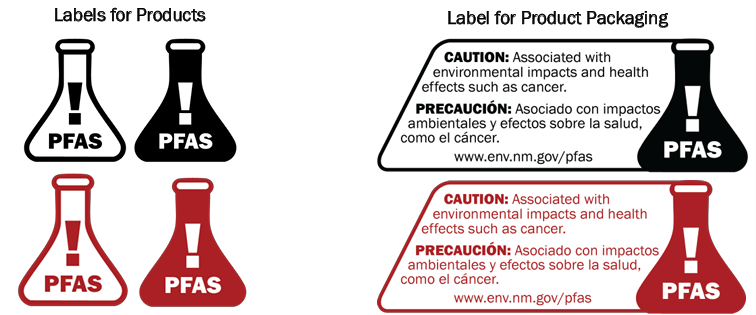
In a September 25, 2025, webinar, NMED shared preliminary label designs that would meet the proposed requirements, shown below.  The department emphasized that the graphics and language are not final.

Example labels for products and labels for product packaging

Exemptions and Special Cases

Used products are exempt from the proposed labeling requirements.  Manufacturers may also request a waiver for products in categories exempt from prohibition and reporting under HB 212—such as medical devices—if they can demonstrate that no PFAS will come into direct contact with consumers during intended use.

Complex durable goods and their components would be subject to alternative labeling requirements but would still need to inform customers of PFAS content.

If other states adopt PFAS labeling requirements, NMED’s proposal would allow manufacturers to comply by meeting comparable labeling rules in another state.

Opportunities for Engagement
  • Public comment period: Open through March 31, 2026.  Submit comments here.
  • Virtual public meeting: October 22, 2025, at 1pm MT (3pm ET).  Register here.
  • Public hearing: Expected around February 18, 2026, per NMED’s public involvement plan.
  • Final rule adoption: Expected by June 30, 2026.

For background on HB 212 and its broader PFAS restrictions, see our previous post.

New Mexico to Hold Webinar on PFAS Labeling on September 25

On September 25, 2025, the New Mexico Environment Department (NMED) will hold an informational webinar on product labelling requirements for PFAS at 1pm MT (3pm ET).  To register, email NMED-PFAS@env.nm.gov.

Under HB212, enacted in April 2025, NMED is authorized to adopt rules requiring that manufacturers label products containing PFAS.  Earlier this month, New Mexico’s Environmental Secretary reportedly told lawmakers that NMED would soon release draft regulations to implement HB 212, including labeling requirements.

PFAS Restrictions and Reporting Under HB 212
  • Labeling authority: NMED may require PFAS labeling.
  • Phased bans: Restrictions on intentionally added PFAS begin in 2027, expand to more product types in 2028, and culminate in a ban on most products in 2032. Exemptions apply for certain products, such as medical devices, and for uses designated by NMED as “currently unavoidable.”
  • Reporting requirement: By January 1, 2027, manufacturers must report information on intentionally added PFAS, including purpose of use and amount (by CASRN).

More details are available on NMED’s PFAS webpage.