New York Carpet Producer Responsibility Program to Launch January 2026

Carpet manufacturers selling in New York state will soon be required to fund a carpet collection and recycling program under New York’s new carpet extended producer responsibility (EPR) program, which is set to begin July 1, 2026.

New York’s carpet EPR law took effect in December 2024, and requires that carpet producers establish or join a collection program approved by the New York State Department of Environmental Conservation (NYSDEC).  Producers may comply individually or by participating in a “representative organization”—the equivalent of a producer responsibility organization (PRO) under other EPR frameworks.

Covered Products

The program applies to most carpet types sold in New York, including but not limited to:

  • Broadloom carpet
  • Modular carpet tiles
  • Artificial turf
  • Carpet pads and underlayment

Handmade rugs, area rugs, and mats are excluded from the program’s scope.

Statutory Requirements

The law establishes phased-in requirements for recycled content and recycling performance based on the number of years following NYSDEC’s approval of a producer’s initial program plan.

One year after plan approval:

  • All carpet sold must contain at least 10% post-consumer recycled content.
  • All carpet must be accompanied with the producer’s name and contact information, as well as the material, composition, and construction type.

Five years after plan approval:

  • All carpet sold must contain at least 20% post-consumer recycled content.
  • Producers must achieve a 30% recycling rate, including at least 10% closed-loop recycling.

Ten years after plan approval:

  • All carpet sold must contain at least 30% post-consumer recycled content.
  • Producers must achieve a 50% recycling rate, with at least 20% closed-loop.

Fifteen years after plan approval:

  • Producers must achieve a 75% recycling rate, of which 40% must be closed-loop.

In addition, starting December 31, 2026, no carpet sold in New York may contain or be treated with PFAS for any purpose.

If a producer or representative organization fails to meet its performance targets, starting four years after plan approval, NYSDEC will assess a penalty of $0.25 per pound for the shortfall—the difference between the actual amount recycled and the amount required to meet the goal.

Key Deadlines
  • December 31, 2025: Deadline for producers or representative organizations to submit their collection program plans to NYSDEC. The department must approve or reject plans within 90 days.
  • July 1, 2026: Producers may not sell carpet into the state unless participating in an approved collection program plan.
  • December 31, 2026: Ban on PFAS-containing carpet takes effect.
  • July 1, 2027: Producers or representative organizations must submit their first annual report to NYSDEC on their program’s implementation.

NYSDEC’s website states that it is “in the preliminary stage of developing” regulations to implement the law.  More information is available in a June 2025 NYSDEC webinar slide deck.

New Mexico Proposes First-Of-Its-Kind PFAS Labeling Requirements

On October 8, 2025, the New Mexico Environment Department (NMED) proposed rules to implement the state’s PFAS Protection Act (HB 212).  In addition to phased-in prohibitions and reporting requirements, the proposal includes novel labeling requirements for all products containing intentionally added PFAS, with a compliance deadline of January 1, 2027.

HB 212 broadly defines PFAS as “a substance in a class of fluorinated organic chemicals containing at least one fully fluorinated carbon atom.”  This definition aligns with those adopted in other states—such as Maine and Minnesota—under their PFAS-in-products laws.

Labeling Requirements

Under the proposed rules, labels must:

  • Inform customers in both English and Spanish that the product contains intentionally added PFAS.
  • Use words and symbols approved by the department.
  • Be “likely to be seen, read and understood by an ordinary individual under customary conditions of purchase or use.”
  • Be “sufficiently durable to remain legible for the useful life of the product.”
  • Use a font size “no smaller than the largest font used for other consumer information on the product.”

For online or catalogue transactions, manufacturers or retailers must clearly disclose PFAS content to customers before purchase on sales literature, webpages, product specification sheets, and marketing materials, as applicable.  If product packaging obscures a label on the product itself, the packaging must be labeled in a compliant manner.

Example Labels

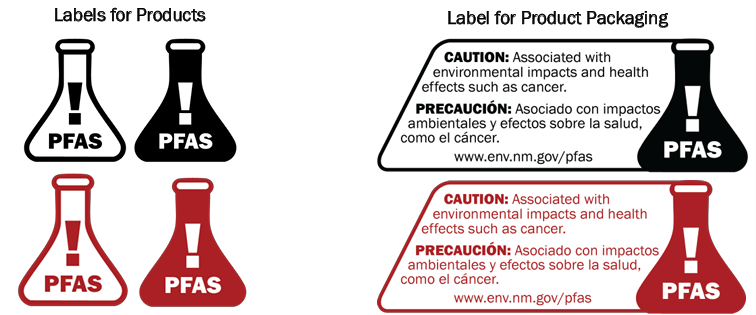
In a September 25, 2025, webinar, NMED shared preliminary label designs that would meet the proposed requirements, shown below.  The department emphasized that the graphics and language are not final.

Example labels for products and labels for product packaging

Exemptions and Special Cases

Used products are exempt from the proposed labeling requirements.  Manufacturers may also request a waiver for products in categories exempt from prohibition and reporting under HB 212—such as medical devices—if they can demonstrate that no PFAS will come into direct contact with consumers during intended use.

Complex durable goods and their components would be subject to alternative labeling requirements but would still need to inform customers of PFAS content.

If other states adopt PFAS labeling requirements, NMED’s proposal would allow manufacturers to comply by meeting comparable labeling rules in another state.

Opportunities for Engagement
  • Public comment period: Open through March 31, 2026.  Submit comments here.
  • Virtual public meeting: October 22, 2025, at 1pm MT (3pm ET).  Register here.
  • Public hearing: Expected around February 18, 2026, per NMED’s public involvement plan.
  • Final rule adoption: Expected by June 30, 2026.

For background on HB 212 and its broader PFAS restrictions, see our previous post.

California Releases Preliminary List of Companies Covered by New Climate Disclosure Laws

On September 24, 2025, the California Air Resources Board (CARB) released a preliminary list of covered entities under two new California climate disclosure laws that will require thousands of companies to report, with initial reporting deadlines beginning in 2026.

California’s SB 261 and SB 253, enacted in 2023, apply to companies formed under U.S. law that do business in California and have total annual revenues above certain thresholds:

  • SB 261 ($500 million threshold): Requires biennial disclosure of climate-related financial risk beginning January 1, 2026.
  • SB 253 ($1 billion threshold): Requires annual disclosure of scope 1 and 2 greenhouse gas emissions for the prior fiscal year beginning in 2026, and scope 3 emissions beginning in 2027. CARB has proposed a June 30, 2026, deadline for the first submission.

For each company, the preliminary list indicates whether reporting is required under both laws or only under SB 261.

SB 261 Reporting Guidance

The preliminary list follows CARB’s September 2 release of draft guidance on compliance with SB 261, which clarifies what information covered entities must include in their biennial reports.

Under the draft guidance, covered entities can choose between three reporting frameworks to meet disclosure requirements for four different areas: governance, strategy, risk management, and metrics and targets.  For each reporting area, the draft guidance outlines minimum disclosure requirements.

The draft guidance acknowledges that disclosures “will vary depending on the company, the discretion of the preparers, and the chosen reporting framework.”  CARB also states that a “guiding principle in preparation of these reports should be meeting the needs of the users of the biennial reports,” such as “investors and other stakeholders.”

Notably, CARB is not currently requiring disclosure of scope 1, 2, or 3 emissions for the initial reporting period.  In addition, companies may submit disclosures based on either calendar year or fiscal year data for their first biennial report.

New Mexico to Hold Webinar on PFAS Labeling on September 25

On September 25, 2025, the New Mexico Environment Department (NMED) will hold an informational webinar on product labelling requirements for PFAS at 1pm MT (3pm ET).  To register, email NMED-PFAS@env.nm.gov.

Under HB212, enacted in April 2025, NMED is authorized to adopt rules requiring that manufacturers label products containing PFAS.  Earlier this month, New Mexico’s Environmental Secretary reportedly told lawmakers that NMED would soon release draft regulations to implement HB 212, including labeling requirements.

PFAS Restrictions and Reporting Under HB 212
  • Labeling authority: NMED may require PFAS labeling.
  • Phased bans: Restrictions on intentionally added PFAS begin in 2027, expand to more product types in 2028, and culminate in a ban on most products in 2032. Exemptions apply for certain products, such as medical devices, and for uses designated by NMED as “currently unavoidable.”
  • Reporting requirement: By January 1, 2027, manufacturers must report information on intentionally added PFAS, including purpose of use and amount (by CASRN).

More details are available on NMED’s PFAS webpage.

California Legislature Moves to Ban PFAS in Many Consumer Products

On September 12, 2025, California’s Assembly and Senate approved SB 682, a bill imposing sweeping prohibitions on the use of intentionally added PFAS in a wide range of consumer products.  The legislation now heads to Governor Gavin Newsom for consideration.

As reported in a previous post, SB 682 would prohibit the distribution, sale, or offering for sale of cleaning products, dental floss, juvenile products, food packaging, and ski wax with intentionally added PFAS starting in 2028, and cookware beginning in 2030.

Since that earlier update, lawmakers amended the bill to exempt certain components of cleaning products until 2031.  The final version also clarifies that, beginning in 2028, cleaning products must comply with California Air Resources Board volatile organic compound (VOC) regulations without reliance on regulatory variances.

Governor Newsom has until October 12, 2025, to act on the bill.

California Packaging EPR Rulemaking Resumes With Key Deadlines Ahead

On August 22, 2025, CalRecycle published proposed regulations to implement California’s SB 54, which imposes a state extended producer responsibility (EPR) program for single-use packaging and plastic food service ware.  Public comments on the proposal are due October 7, 2025, the same day CalRecycle will hold a hybrid public hearing.

The rulemaking is CalRecycle’s second attempt to implement SB 54.  In March 2025, California Governor Gavin Newsom directed CalRecycle to restart the rulemaking process, citing concerns with its costs.

What does SB 54 Require?

SB 54 is designed to shift the burden of plastic pollution from consumers to producers, which are “typically the companies that create—or package their products in—single-use packaging and single-use plastic food service ware,” according to CalRecycle.  Beginning in 2027, producers will pay fees totaling $500 million per year to offset recycling costs and environmental impacts.

By 2032, all covered materials must be recyclable or compostable, and at least 65% must actually be recycled.  SB 54 also mandates a 25% source reduction in plastic covered material compared to 2023.

Upcoming Compliance Deadlines for Producers

Producers face several near-term obligations under the program:

  • September 5, 2025: Deadline to register with California’s inaugural producer responsibility organization (PRO), Circular Action Alliance (CAA), which will oversee program administration and fee collection.
  • September 15, 2025: CAA opens its reporting portal.
  • November 15, 2025: Deadline to submit 2023 supply data through the portal.

As discussed in a previous blog post, an increasing number of states are implementing packaging EPR laws.  Our team is available to help businesses navigate this evolving regulatory landscape.

California Legislature Advances Bill to Expand PFAS Product Prohibitions

California has taken another significant step towards restricting the use of PFAS in consumer products with the advancement of SB 682, a bill that would add several new product-category PFAS bans beginning in 2028.  SB 682 has already passed the state Senate and is pending in committee in the Assembly.

What Products Would be Affected by SB 682?

Starting in 2028, SB 682 would prohibit the sale of products with intentionally added PFAS for the following product categories:

  • Cleaning products;
  • Dental floss;
  • Juvenile products;
  • Food packaging; and
  • Ski wax.

Starting in 2030, SB 682 would also prohibit the sale of cookware containing intentionally added PFAS.  Used products are exempt from the scope of the bill.

Existing Restrictions

SB 682 would not be the first California law to address the use of PFAS in the above product categories.  Since 2023, the state has prohibited the sale of plant fiber–based food packaging containing intentionally added PFAS, and beginning in 2024, cookware manufacturers have been required to disclose PFAS use on food contact surfaces.

California also enacted a ban on intentionally added PFAS in certain juvenile products in 2023.  SB 682 would broaden that restriction, extending it to any “product designed for use by infants and children under 12 years of age,” with limited exceptions.

Looking Ahead

If enacted, SB 682 would be California’s most far-reaching PFAS law to date, and its full Democratic support among voting senators signals a strong likelihood of passage in the Assembly.  Given California’s outsized market influence, the bill could also have spillover effects beyond state borders, encouraging broader adoption of PFAS-free product formulations.

California Proposes Listing Microplastics as an SCP Candidate Chemical

California’s Department of Toxic Substances Control (DTSC) has proposed to designate microplastics as a “candidate chemical,” a move that could lead to future regulation of products that contain or generate microplastics under the state’s Safer Consumer Products (SCP) program.

Adding microplastics to the SCP candidate chemical list would not in itself create new regulatory requirements.  However, it would allow SCP to evaluate specific types of products containing microplastics for possible designation as a “priority product,” which could ultimately result in restrictions or other regulatory measures.

“Microplastics are pervasive, persistent, and increasingly linked to potential risks to human health, wildlife and the environment,”  DTSC stated in a June 20 press release.  “They have been found in nearly every corner of the planet, including oceans, soil, indoor air, and even on the highest mountain peaks.”

The press release also highlights the “economic burden” of microplastic pollution, noting that “healthcare costs linked to plastic-associated chemicals are projected to exceed $144 billion by 2025” in California.

A technical document accompanying the proposal defines microplastics as “plastics that are less than 5 millimeters (mm) in their longest dimension, inclusive of those materials that are intentionally manufactured at those dimensions or are generated by the fragmentation of larger particles.”

The document acknowledges the “structural heterogeneity and complexity of different plastic polymers,” but argues that microplastics still constitute a “chemical” under SCP’s governing regulations.

The proposal was foreshadowed by SCP’s most recent priority products work plan, released in 2024 and discussed in a previous blog post.  For the first time, the work plan identified products containing or generating microplastics as a consumer product category warranting evaluation for priority products.

Comments on the proposal will be accepted through August 4 via CalSAFER.

DTSC Finalizes SCP Priority Product Work Plan

This October, California’s Department of Toxic Substances Control (DTSC) released the final version of the Safer Consumer Products (SCP) Program’s Three-Year Priority Product Work Plan for 2024–2026.  The work plan identifies eight categories of consumer products that DTSC will evaluate to determine whether specific products within those categories should be designated as Priority Products—product-chemical combinations that may be subject to regulation.

Four categories remain largely unchanged from the 2021-2023 work plan:

  • Beauty, personal care, and hygiene products;
  • Cleaning products;
  • Building products and materials used in construction and renovation; and
  • Children’s products.

Two existing categories have been expanded:

  • Food packaging—expanded to include food contact articles; and
  • Motor vehicle tires—expanded to include motor vehicle parts, accessories, maintenance, and repair materials.

Finally, two new categories have been added:

  • Paints (previously included under building products); and
  • Products that contain or generate microplastics.

The work plan also touches on Senate Bill 502.  That 2022 California law expanded DTSC’s authority under the SCP Program, granting DTSC greater power to require product manufacturers to disclose product ingredients.  Importantly, the bill also established a process for DTSC to move directly to regulatory response for a Priority Product, bypassing an Alternatives Analysis.

A full list of Candidate Chemicals—substances that may lead to a product’s prioritization—is available on DTSC’s website.

Maine Releases Draft Language Clarifying Proposals for Currently Unavoidable PFAS

This August, the Maine Department of Environmental Protection (DEP) released draft language to implement April 2024 amendments to Maine’s PFAS in products legislation.  The draft language was described by DEP as an “initial, informal outreach process” with the goal of initiating rulemaking this fall.

Under Maine’s PFAS in Products law, DEP has broad authority to determine whether PFAS uses are “currently unavoidable.”  Currently unavoidable uses (CUUs) will be granted a five-year exemption to the amended statute’s incremental sales prohibitions for products containing intentionally added PFAS.

Tight timelines

Under the draft language, CUU proposals would only be accepted 18–36 months prior to the applicable sales prohibition or 12–24 months prior to the expiration of an existing CUU determination.  However, sales prohibitions for cleaning products, cookware, cosmetics, and other products containing intentionally added PFAS take effect in less than 18 months (January 1, 2026).  In an October 1 email, DEP stated that they “recognize the tight timeline with the new statutory prohibitions starting in 2026 and are making efforts to streamline the process as much as possible.”

DEP solicited currently unavoidable use proposals for the 2026 prohibitions earlier this year, before the April amendments forced the department to redraft its rulemaking.  In the email, DEP clarified that they are “still considering” whether they will be able to utilize some of the previously submitted information and that “manufacturers may need to resubmit information” to meet the requirements of the eventual final rule.

Proposal requirements

According to the draft language, proposals for CUU determinations could be submitted by manufacturers individually or collectively.  A separate proposal would be required for each combination of product category and industrial sector.  As part of the proposal, manufacturers would be required to include:

  • An explanation of why use of PFAS in the product is “essential for health, safety or the functioning of society” and “essential to the function of the product”;
  • A description of whether alternatives to the use of PFAS are reasonably available;
  • Information on whether and how other states have regulated the use of PFAS in the product; and
  • Known or reasonably ascertainable information on the product’s health and environmental impacts.

The draft language “strongly recommends that all proposals for currently unavoidable use determinations do not contain claims of confidentiality” because “the Department may determine that there is insufficient publicly available information to justify a rulemaking.”

Other provisions of the draft rulemaking, including the notification requirements for manufacturers of products covered by a currently unavoidable use determination, largely mirror the requirements of the amended statute.  More information on the April 2024 amendments can be found in a previous blog post.