
Ninth Circuit rules on “all natural” food claims.

Last week, the Court of Appeals for the Ninth Circuit reversed in part and affirmed in part orders issued by a district court judge in a putative class action case involving “all natural” claims made by Dole Foods. In Brazil v. Dole, No. 14-17480 (9th Cir. Sept. 30, 2016), the plaintiff, Chad Brazil, alleged that Dole’s “All Natural Fruit” labels for packaged fruit products were deceptive under the California Unfair Competition Law (UCL), California False Advertising Law (FAL), and California Consumer Legal Remedies Law (CLRA).

The plaintiff claimed that the labels were deceptive because the products contain synthetic citric and ascorbic acid, citing evidence including informal policy issued in 1993 by the federal Food and Drug Administration (FDA), as well as more recent FDA warning letters to food sellers making similar claims (“100% Natural” or “All Natural”). The FDA’s informal policy [PDF] states that a “natural” claim on a food label is truthful and non-misleading when “nothing artificial or synthetic… has been included in, or added to, a food that would not normally be expected in the food.” In the warning letters, FDA described “natural” claims as deceptive because the food products included synthetic citrus acid, among other substances.

Upon appeal, the Ninth Circuit affirmed the lower court’s order decertifying the class because the plaintiff failed to show how to calculate the price premium with proof common to the class. The Court also affirmed the dismissal of the plaintiff’s claims for the sale of “illegal products.”

However, the Ninth Circuit reversed the district court’s granting of summary judgment on the merits of Brazil’s claims. The Court held that the evidence presented “could allow a trier of fact to conclude that Dole’s description… is misleading to a reasonable consumer.” Interestingly, the Court noted that the FDA warning letters “did not always rely on the limitation that an artificial or synthetic product would ‘not normally be expected to be in the food’ – and, in fact, asserted that foods that naturally contain citric acid (such as tomatoes) may not be labeled ‘all natural’ if synthetic citric acid is added to them.”

While unpublished, the Ninth Circuit’s opinion [PDF] may prove consequential because it suggests how the Court may interpret “natural” claims in the future. In addition, a number of other cases involving “natural” claims have been stayed while this case has been pending and the plaintiff’s bar may be emboldened to pursue further litigation.

The case has been remanded to the lower court to allow the plaintiff “injunctive relief on behalf of the class and his remaining individual claim for restitution.”
Seventh Generation Settles “Natural” Claims Class Action For $4.5M

Consumers in this class action claimed that Seventh Generation Inc. deceptively labeled its cleaning products as “natural” even though they contained synthetic preservatives. Seventh Generation has agreed to pay $4.5 million to settle this case in New York federal court.

Seventh Generation makes several household cleaning items such as laundry detergent, glass cleaner, and dish soap. The products in question are natural laundry detergent, natural 4X concentrated laundry detergent, ultra power plus natural laundry detergent, natural dish liquid, and ultra power plus natural dish liquid. They were available for sale in stores such as Walgreens, Walmart, Target, Amazon.com, Bed Bath & Beyond, and Whole Foods.

The consumers alleged that the company incorrectly used the term “natural,” despite the fact that two of the ingredients — Methylisothiazolinone (“MIT”) or Benzisothiazolinone (“BIT”) — are synthetic. MIT and BIT are antimicrobial preservatives.

In its press release, Seventh Generation stood by its “natural” labeling, but cited burdensome litigation costs as its reason for settlement. Under the terms of the settlement, Seventh Generation will remove the “All Natural” and “100% Natural” claims, and will add clarifications about the non-toxic and hypoallergenic claims. Additionally, Seventh Generation will provide compensation to eligible claimants.

This lawsuit is one of several settled and pending cases against companies claiming that their products are natural, but contain synthetic substances. See Earth Friendly Settlement and Tom’s of Main Settlement.

Supreme Court denial upholds FTC on substantiating claims in advertising.

Green marketers take note: the Federal Trade Commission (FTC) won a recent victory at the Supreme Court on deceptive advertising, which means companies cannot advertise health benefits for their products without sufficient evidence.

On May 2, the Supreme Court denied POM Wonderful’s petition for certiorari, bringing to an end a six-year-long wrangle with the FTC over advertisements that claimed the company’s pomegranate juice was clinically proven as effective in fighting heart disease, prostate cancer, and erectile dysfunction.

The Supreme Court’s denial leaves in place the January 2015 decision [PDF] from the D.C. Circuit Court of Appeals, which upheld the Commission’s decision that POM misled consumers in violation of the FTC Act. Specifically, the D.C. Circuit upheld the Commission’s findings as to (1) establishment and efficacy claims made in POM’s advertising, as well as (2) inadequate substantiation for those claims.

The D.C. Circuit also affirmed the FTC’s cease and desist order [PDF], which requires POM to substantiate any future disease treatment and prevention claims with at least one randomized, well-controlled human trial, while other health benefit claims must be supported by competent and reliable scientific evidence.

In a statement, FTC Chairwoman Edith Ramirez lauded the Supreme Court’s move, saying the conclusion of the case “makes clear that companies like POM making serious health claims about food and nutritional supplement products must have rigorous scientific evidence to back them up.”

EPA seeks input on ecolabels for paints, flooring, and furniture.

As part of its pilot project to test its “Draft Guidelines for Product Environmental Performance Standards and Ecolabels for Voluntary Use in Federal Procurement,” the Environmental Protection Agency (EPA) is seeking input on private sector environmental performance standards and ecolabels applicable to paints/coatings, flooring, and furniture. According to the Information Collection Request (ICR) submitted to the Office of Management and Budget (OMB), the Agency is expecting responses from standards development organizations, ecolabel programs, and certification entities with environmental performance standards for products. EPA is also asking these entities to participate in self-assessments, using checklists specific to each product category and based on the draft Guidelines, as well as in follow-up interviews with an independent assessor. The ICR was announced in a Federal Register notice published on Monday; public comments on the ICR must be received by May 25, 2016.

EPA developed the draft Guidelines in 2013 to help federal purchasers select appropriate private sector ecolabels and standards for environmentally preferable purchasing. In the ICR, EPA states: “While Federal purchasing policy is clear for the several standards and ecolabels that are listed in statute, regulation, or Executive Order, the lack of independently assessed information about and federal guidance on using other product environmental performance standards and ecolabels often results in an inconsistent approach by Federal purchasers and confusion and uncertainty for vendors and manufacturers.” With this ICR, EPA seeks to address this problem by testing an approach to determine which standards and ecolabels to support “in a fair, transparent, and consistent manner.” Ecolabels and standards will be assessed based on the criteria used in developing and managing the standards and ecolabels as well as “the effectiveness of the standards in ecolabels in protecting environmental and human health.”

EPA is contracting with two companies, Resolve and Industrial Economics, to conduct the pilot project to further refine the draft Guidelines and test how to assess standards and ecolabels. Resolve will “convene a coordinating Governance Committee, product category-specific multi-stakeholder panels,” while Industrial Economics will “develop and pilot test an approach” to assess standards and ecolabels in paints/coatings, flooring, and furniture.

Along with the ICR itself, the pilot project’s survey and assessment criteria are also available in the ICR’s docket (EPA-HQ-OPPT-2014-0838) on Regulations.gov.

FTC enforces on “all natural” claims in personal care products.

Today, the Federal Trade Commission (FTC) announced proposed settlement agreements and consent orders with four companies for falsely marketing shampoos, sunscreen, and skincare products as “all natural” or “100% natural.” A fifth company was issued an administrative complaint for marketing “all natural sunscreen” that contains “a synthetic ingredient,” dimethicone. Other ingredients cited as “synthetic” by the FTC in the proposed consent orders include ethylhexyl glycol, phenoxyethanol, polyethylene, polyquaternium-37, polyquaternium-7, and caprylyl glycol. The complaints against all five companies allege that using such “synthetic” ingredients renders “all natural” claims false or misleading.

In these cases, the FTC’s proposed orders bar the companies from making misrepresentations in marketing a product about the following:

  • Whether the product is all natural or 100% natural;
  • The extent to which the product contains any natural or synthetic ingredient or component;
  • The ingredients or composition of the product; or
  • The environmental or health benefits of the product.

However, representations about these subjects are allowed under the proposed consent orders if the company “possesses and relies upon competent and reliable evidence” or “competent and reliable scientific evidence” that is “sufficient in quality and quantity based on standards generally accepted in the relevant fields when considered in light of the entire body of relevant and reliable evidence, to substantiate that the representation is true.”

Notably, today’s actions are not accompanied by an Enforcement Policy Statement or other guidance for companies not subject to the consent orders. FTC has raised questions in these enforcement actions such as: Which other commonly used ingredients in personal care products are “synthetic”? How does FTC determine whether a substance is “synthetic” or “natural”? Do plant-based versions of caprylyl glycol, for example, count as “synthetic”? Are processes and production considered as part of the “synthetic” vs. “natural” distinction, or just the sources or raw materials of the ingredients?

“All natural” claims are particularly difficult to substantiate because such claims are interpreted by consumers in a variety of different ways, and the various federal agencies that have jurisdiction over such claims in the United States have not provided much clarity. When issuing the revised Green Guides in 2012, for example, the FTC declined to provide guidance on “all natural” claims, citing the lack of data on how consumers interpret such claims. A December 2015 survey [PDF] by Consumer Reports found that misunderstanding about the meaning of “natural” in the food world was widespread; more than 80% of shoppers thought that in the context of processed foods, “natural” meant no pesticides were applied in production, no chemicals were used in processing, and that the food contained no Genetically Modified Organisms (GMOs) or artificial ingredients or colors. Meanwhile, the Food and Drug Administration (FDA) is still collecting public comments, through May 10, 2016, on using the term “natural” in food labeling.

FDA seeks input on “natural” food labels.

Last week, the U.S. Food and Drug Administration (FDA) announced that it is seeking comments and information on the use of the term “natural” in food labeling. The move is in response to three citizen petitions, from industry stakeholders, requesting that the agency define “natural” for food labeling and one citizen petition, from Consumers Union, asking for a prohibition on the term. The FDA also stated that it is working with the U.S. Department of Agriculture (USDA) to examine “natural” labeling for meat, poultry, and egg products.

The last time the FDA considered establishing a definition for “natural” in food labeling was 1991, when it published a proposed rule on labeling and sought comment on whether the agency “should establish a meaningful definition for ‘natural’ so that this term would have a common consumer understanding, and whether it should prohibit ‘natural’ claims entirely on the grounds that they are false or misleading.” FDA declined to define “natural” by rulemaking in 1993, but has continued to maintain its policy that labeling a food as “natural” means that “nothing artificial or synthetic (including all color additives regardless of source) has been included in, or has been added to, a food that would not normally be expected to be in that food.” Critically, the FDA’s policy does not address methods of food production (like genetic engineering or pesticide use) or processing and manufacturing (like pasteurization), nor whether “natural” describes any nutritional or health benefit.

The three petitions to the FDA regarding “natural” labeling all seek guidance on whether “natural” can apply to certain methods of food production, processing, and manufacturing. Two of the petitioners requested better harmonization with the USDA’s Food Safety Inspection Service standards. The Consumers Union petition, seeking a prohibition on “natural” food labeling, argues that “natural” is “vague and misleading,” citing a Consumer Reports National Research Center survey. That survey “suggests that nearly two-thirds of U.S. consumers are currently misled by use of the term ‘natural’ on certain food labels and nearly 90 percent expect it to ‘mean much more than it does.’”

The FDA has posed several specific questions to commenters on when “natural” labeling is misleading to consumers, including input on application to food production, processing, and manufacturing practices, as well as a request for consumer perception data on confusion with terms like “healthy” and “organic.” The agency is accepting comments through February 10, 2016, via docket number FDA-2014-N-1207.

FTC warns users and providers of environmental certification seals.

Earlier this month, the Federal Trade Commission (FTC) sent warning letters to five providers of environmental certification seals and 32 businesses using those seals on their websites. The FTC is concerned that the seals may be deceptive according to Section 5 of the FTC Act, and may not comply with the agency’s environmental marketing guidelines, known as the “Green Guides.” The letters request that the recipients advise on what steps they are taking to bring their marketing into compliance. The agency is not disclosing the names of the companies that received the warning letters.

According to the Green Guides, unqualified general environmental benefit claims and environmental certificates or seals are likely to convey a wide range of meanings to consumers; i.e., consumers may see a picture of a leaf or the word “green” and assume that means the product is made of recycled materials or manufactured with renewable energy, even if those claims are nowhere to be found. Thus, the Guides caution marketers against using unqualified general environmental benefit claims – like “eco-friendly” – or environmental seals that do not convey “the basis for the certification.”

According to the warning letters, the environmental certification logos at issue do not convey the basis for the certification and are not accompanied by “clear and prominent qualifying language that limits the claim to a specific benefit.” Furthermore, the FTC cites their “.com Disclosures” guidance in noting that such a logo on a company’s website is “not likely an effective hyperlink label leading to the necessary disclosures.”

In its Business Blog, the FTC has a post on “Performing seals” which discusses the matter and advises on the following “key principles” about the use of environmental certifications and seals of approval:

  • Without careful qualification, general environmental benefit claims pose a risk of deception. Under the FTC Act, deception can occur inadvertently if the marketer does not have substantiation for consumers’ interpretations of claims. For example, if a product conveys an unqualified “eco-friendly” claim, and a consumer interprets that to mean that the product is carbon neutral and non-toxic, then the product maker may be on the hook for deception unless it has evidence to prove that the product is, in fact, carbon neutral and non-toxic.
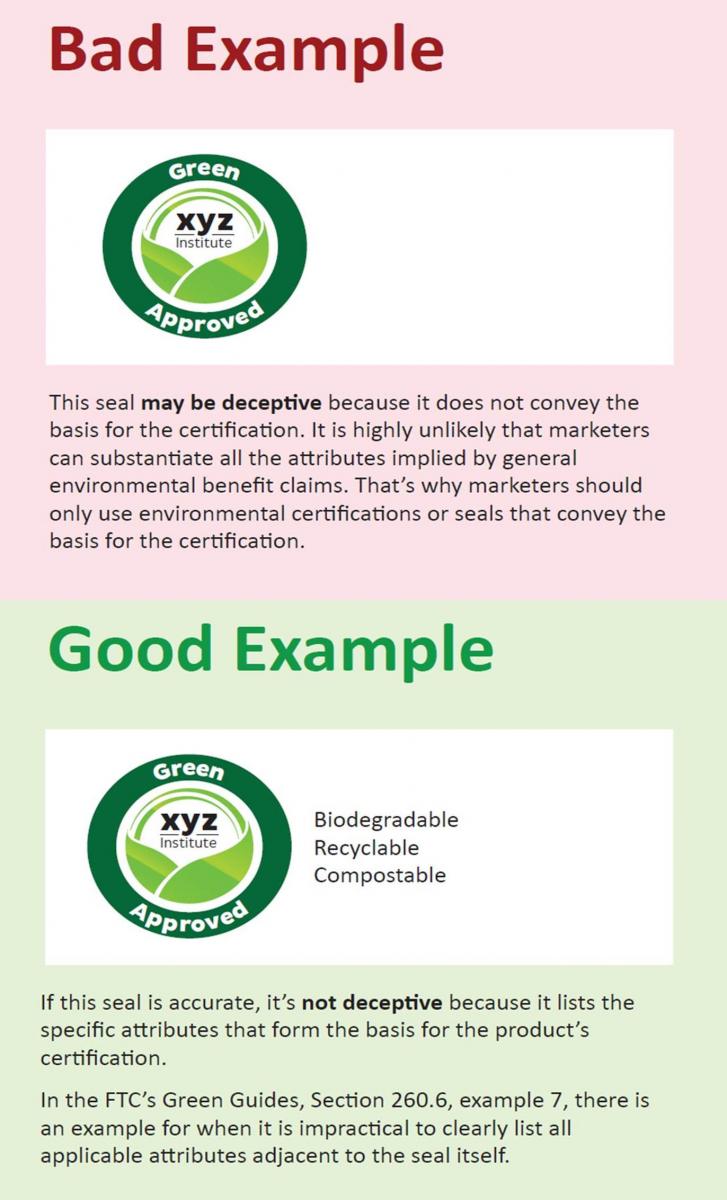
  • Certifications and seals that don’t explain the reason for the thumbs-up may convey broad claims that can’t be substantiated. BecGreen Certification Examples - Good and Badause it is unlikely that companies can substantiate the vast array of claims that consumers can potentially interpret from an unqualified environmental certification seal, the FTC urges against using “seals that do not convey the basis for the certification.” The FTC’s blog post also includes a helpful visual illustrating good and bad examples of using an environmental certification seal (at right):
  • Companies can take steps to reduce the risk of deception. As discussed in the Green Guides, visuals like certification logos should be accompanied with “clear and prominent qualifying language that clearly conveys that the certification or seal refers only to specific and limited benefits.” In the “Good Example” of an environmental certification seal, for example, the words “Biodegradable,” “Recyclable,” and “Compostable,” are clearly displayed next to the certification logo.
  • Logos themselves aren’t likely to be effective hyperlinks. Companies should not assume that readers will click on the logo image, and instead include explanatory information in large, easy-to-understand text, right next to the logo. In cases where not all attributes can be listed next to the seal, companies should display sufficient information upfront to explain why readers should click the clear and prominently placed link.
  • Both the certifier and the advertiser have responsibilities under Section 5 of the FTC Act. In its letters to certifiers, the FTC notes that the certifiers’ websites do not appear to provide instructions to marketers on using qualifying language.
  • The FTC has resources for companies that want to keep green claims clean. Here, the FTC refers to the Green Guides as well as its Statement of Basis and Purpose [PDF] for more detail. More resources are available on the FTC’s Environmental Marketing

The FTC has not determined whether the letter recipients’ claims violate the law and is not taking any law enforcement actions at this time.

Alternatives Assessments for flame retardants in flexible polyurethane foam and printed circuit boards finalized.

Yesterday, EPA released two final Alternatives Assessment reports, for flame retardants used in flexible polyurethane foam and printed circuit boards, as well as a technical correction to an alternatives assessment report on bisphenol A (BPA) in thermal paper. These reports were developed under the agency’s Design for Environment (DfE) program to characterize chemical hazards and identify safer chemicals, and continue EPA’s scrutiny of flame retardant chemicals.

The final Alternatives Assessment for flame retardants used in flexible polyurethane foam finalizes the draft update, released in June 2014, to a 2005 report on the flame retardant pentabromodiphenyl ether (pentaBDE). PentaBDE was voluntarily phased out by industry in the U.S. in 2004, and is subject to a proposed Significant New Use Rule and section 4 test rule under the Toxic Substances Control Act (TSCA) as part of the EPA’s Polybrominated Diphenyl Ethers (PBDEs) Action Plan. The final report evaluates 19 alternatives, including one non-proprietary mixture and two proprietary mixtures, and covers all upholstered consumer products containing flexible polyurethane foam, including car seats and nursing pillows. In addition, EPA released a document responding to public comments to the draft report [PDF].

EPA also finalized its Alternatives Assessment report for flame retardants in printed circuit boards used in electronic products, like computers and cell phones, and released a response to comments on the 2014 draft report [PDF]. The Alternatives Assessment was published in draft form in December 2014 as an update to a draft first released in 2008. As in the 2014 draft, the final Alternatives Assessment focuses on alternatives to tetrabromobisphenol-A (TBBPA), a commonly used halogenated flame retardant which is also the subject of a recently released TSCA Work Plan Problem Formulation and Initial Assessment. Based on a confidential study and comment submitted following the release of the 2014 draft report, the final Alternatives Assessment changed the skin sensitization designation for magnesium hydroxide from Moderate to Low. Responding to another comment, EPA elaborated on performance testing of halogen-free flame-retardant printed circuit boards, which reportedly “found that the eight halogen-free flame retardant laminates tested generally outperformed the traditional… laminate control.”

The technical correction revises a final Alternatives Assessment report for BPA in thermal paper originally released in January 2014. BPA, a high production volume (HPV) chemical, is commonly used as a developer in thermal paper, like cash register receipts. The correction changes the developmental toxicity designation of one alternative, Pergafast 201, from High to Moderate. The change is based on further analysis of new data submitted in response to the draft report.

EPA replaces Design for the Environment with new “Safer Choice” label.

Today, EPA unveiled its new “Safer Choice” label, which replaces the Design for the Environment (DfE) label for cleaning and other chemical products that meet the agency’s standards for safer chemical ingredients. The new label underscores the program’s focus on human health and environmental safety standards with the hope of making it easier for families to choose safer products for families. EPA Administrator Gina McCarthy even appears with her dog in a short YouTube video to emphasize that children and pets are more vulnerable to chemicals.

The new “Safer Choice” label has different versions for products used in homes and for those used in office buildings, schools, and other institutions.

Speaking at a conference in Baltimore yesterday, Wendy Cleland-Hamnett, director of EPA’s Office of Pollution Prevention and Toxics, said the agency consulted with the Federal Trade Commission (FTC) in developing in the new logo to ensure that it would comply with the FTC’s Green Guides on environmental marketing claims.

EPA also introduced a new label to substantiate fragrance-free claims in Safer Choice products. The revised “Safer Choice Standard” [PDF] specifies changes related to the new fragrance-free standard. Products that qualify for the Safer Choice label are eligible for the additional fragrance-free certification and label if no fragrance materials are in the product ingredients.

In addition, the agency announced that it “is aligning across product types the requirements applied to labeled products that contain sensitizers that exceed the de minimis level (0.01%) in the end-use product.” All Safer Choice products, not just consumer products, will now be required to disclose on the label if fragrance materials that are skin sensitizers are present above the de minimis level. Manufacturers of such products will also be required to provide EPA with information that the sensitizing ingredients are:

  • critical to the fragrance essence or product identity;
  • otherwise in compliance with the fragrances criteria;
  • the subject of good faith explorations of alternatives; and
  • subject to a monitoring system that would alert the Agency if a user reports any adverse effects from the product.

The new label does not change other aspects of the DfE program, such as safer chemical criteria.

On the agency’s blog, Administrator McCarthy wrote that producers and retailers including Clorox, Walmart, and Wegmans are on board to start putting products with the new label on shelves this year.

EPA’s chemicals outlook for 2015.

Jim Jones, the EPA Assistant Administrator for Chemical Safety and Pollution Prevention, writes in Chemical Watch that his highest priority in 2015 is “to continue building on the progress” of the last few years in making a “credible” program to manage existing chemicals, “despite the widely acknowledged shortcomings of the Toxic Substances Control Act (TSCA).” In his outlook for 2015, Assistant Administrator Jones highlighted progress on the TSCA Work Plan for Chemical Assessments as well as various regulatory actions.

Assistant Administrator Jones noted that in 2014, EPA completed final assessments on four chemical substances. Of those, the assessments for trichloroethylene (TCE) and methylene chloride (DCM) identified health risks to consumers and workers working with the chemicals. In 2015, the agency intends to negotiate for voluntary risk reduction measures with TCE and DCM manufacturers, but would turn to TSCA § 6 to mandate risk management – a regulatory tool EPA has not used in 28 years. Under the TSCA Work Plan, assessments scheduled for 2015 will address the following:

  • N-Methylpyrrolidone (NMP) in paint stripper products;
  • three clusters of related chemicals, used as flame retardants;
  • several uses of 1-Bromopropane (1-BP); including occupational uses of 1-BP in dry-cleaning and foam gluing operations, consumer uses in aerosol solvent cleaners and spray adhesives;
  • 1,4-Dioxane; and
  • long- and medium-chained chlorinated paraffins used as metal working and compounding agents and its effects on ecological receptors.

EPA has a variety of regulatory actions planned for 2015. The agency plans to finalize a rule regulating formaldehyde emissions from composite wood products, thus making national the emissions standard already in place in California. In addition, EPA will make a determination on “whether renovations in commercial and public buildings create a hazard from lead-based paint.” Assistant Administrator Jones also announced that the agency will, in late 2015 or early 2016, propose the modification of existing use authorizations for polychlorinated biphenyls (PCBs) in several contexts. Finally, Assistant Administrator jones noted that 2015 would mark a “turning point” for the agency’s green chemistry programs as incentives and obstacles to adoption of greener chemistries are identified.

Other items on EPA’s agenda for 2015 include: